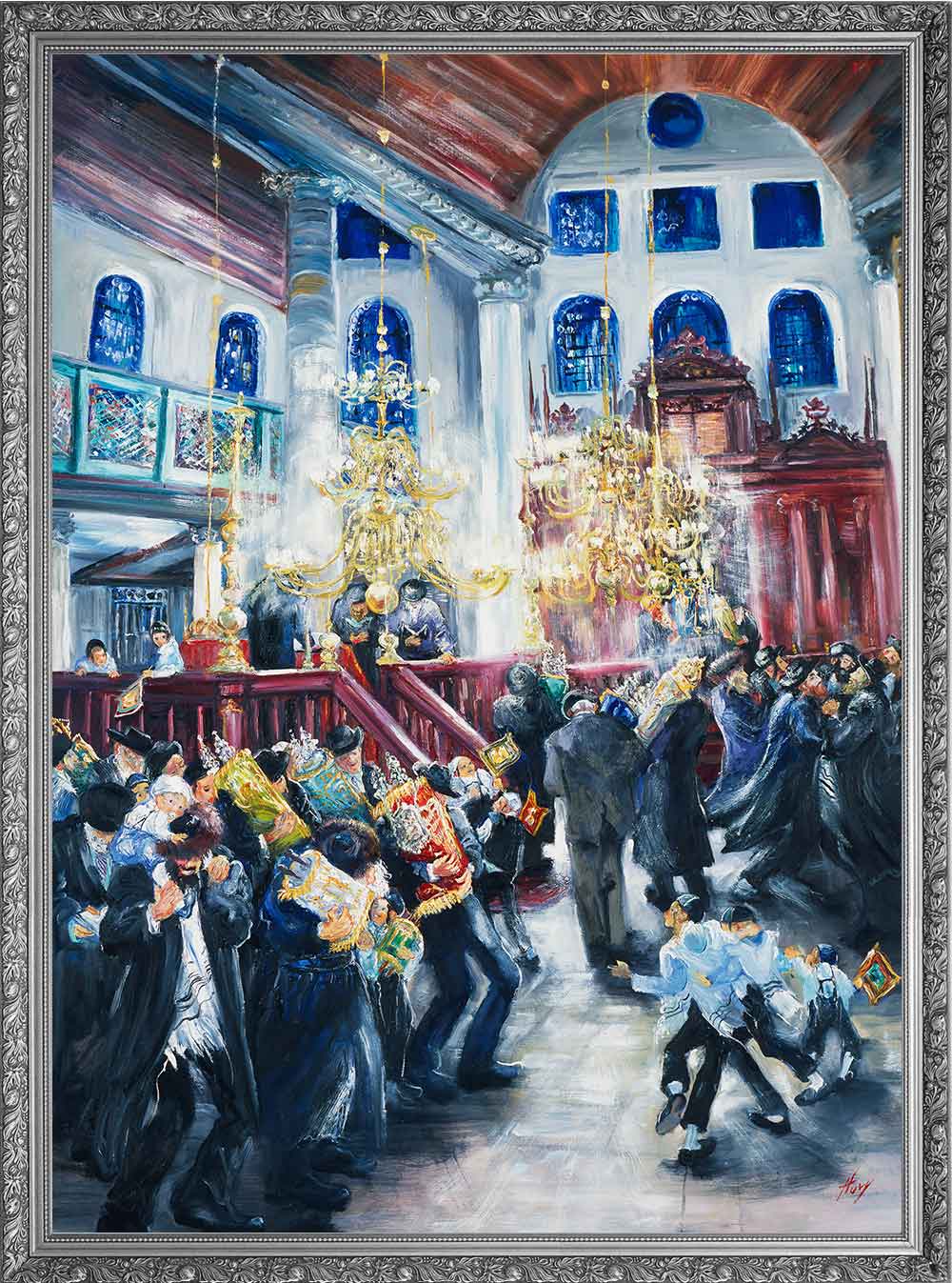
In Jewish tradition, joy is more than a fleeting mood; it can be an important part of religious and communal life, often expressed through the concept of Simchat Mitzvah. Whether you are dancing at a wedding, celebrating Simchat Torah, or celebrating the water-drawing festival of Simchat Beit HaShoevah, finding joy through religious practice has an important place in Jewish tradition.
For the late Israeli post-impressionist painter Huvy (Ahuva) Elisha (1927–2022), this spiritual theme became an important element of her artistic work. Formally trained at London’s Saint Martin’s School of Art, Huvy combined elements of European Impressionism with subjects and traditions drawn from Jewish life in Jerusalem. Hanging a piece from Huvy’s Gallery on your wall goes far beyond simple home decoration – it can bring a sense of light, faith, and optimism into a contemporary living space.
What Is “Simchat Mitzvah” on Canvas?
A common distinction in Jewish art is the difference between ceremonial objects and fine art that interprets Jewish life through an artistic lens. Many traditional artists paint Jewish celebrations like a historical document-carefully rendering every single thread, beard, or architectural brick.
Huvy did something completely different. Living and painting in Jerusalem, drawing deep inspiration from the streets of Mea She’arim and the Western Wall, her paintings focus less on literal details and more on the movement, emotion, and spiritual atmosphere surrounding Jewish religious life.
- Vision Over Static Reality: Huvy’s work emphasizes memory, inner vision, and spiritual expression rather than purely photographic representation.
- Filtering Out the Noise: Her emphasis on memory and inner vision allows the compositions to move beyond background detail, focusing attention on the rhythm and emotion of the dance.
The Mechanics of Motion: Capturing Jewish Ecstasy
Why do Huvy’s wedding and dance scenes feel so vividly alive? It all comes down to her technical execution. Her background in London and Paris gave her a classic foundation, which she developed further through her work in Jerusalem.
She rejected flat, smooth surfaces in favor of heavy impasto-applying thick, three-dimensional layers of oil paint with palette knives and broad brushes.
What makes this technique particularly effective is how it uses real-world light to create visual movement. When light hits the raised ridges of the paint, it casts tiny micro-shadows across the canvas. As you walk past the painting or as natural sunlight changes in your room, the changing light can create subtle variations in how the texture and brushwork are perceived from different angles.
By avoiding sharp, rigid outlines, her figures blend naturally into one another. The dancers, their prayer shawls (tallitot), and the Jerusalem backdrop merge into a single wave of celebration. In her scenes of Hakafot (festive dance circles), her compositions can use circular movement and swirling arcs of white, gold, and crimson that guide your eye in an unbroken loop, echoing the endless cycle of Jewish tradition.
Selected Works: Themes and Visual Elements
| Masterpiece Theme | Key Visual Elements | Emotional & Spatial Impact |
| Hasidic Wedding Under the Canopy | Glowing whites, rich gold, soft blues | Symbolizes hope, family foundations, and divine blessing |
| Dancing Hakafot (Simchat Torah) | Swirling figures, fiery reds, deep oranges | High-energy celebration, passion, and spiritual devotion |
| Simchat Beit HaShoevah & Sukkot | Emerald greens, warm ochres, radiant gold | Radiates warmth, divine abundance, and hospitality |
In her wedding paintings, the Chuppah isn’t just a piece of fabric; it’s rendered as a canopy of divine light hovering over the couple. The surrounding guests are painted with fast, expressive strokes, reminding us that a Jewish wedding is a collective joy for the entire community.
Similarly, her Simchat Beit HaShoevah paintings evoke the ancient celebration described by the sages as an extraordinary expression of joy. The glowing oranges and warm yellows can make these canvases particularly well suited to dining rooms and spaces dedicated to hosting.
Original Oils vs. Hand-Embellished Prints
When choosing a piece through Huvy’s Gallery, collectors generally choose between two primary formats:
- Original Oil Paintings: A strictly finite body of work following Huvy’s passing. These carry her personal knife marks, direct handiwork, and the historical significance of being original works by the artist-making them particularly relevant to collectors seeking original works by the artist.
- Hand-Embellished Mixed Media Prints: Printed on high-grade canvas and individually retouched with physical oil paint by Huvy’s granddaughter (who was trained directly in Huvy’s impasto methods). This offers physical texture, custom sizing options, and a different way of experiencing the artwork at a more accessible price point than an original.
What Interior Designers Frequently Overlook
A common consideration when displaying energetic artwork is to avoid treating it like a quiet, passive print. Placing dynamic art in your home requires a bit of strategy:
- The Common Mistake: Choosing a piece that is too small for the wall. Movement-heavy art needs room to breathe. On a massive blank wall, a tiny dynamic painting loses its power.
- Frame Selection: Avoid heavy, dark wooden frames that box in the energy. Sleek float frames (in white, natural wood, or soft gold) allow the canvas edges to interact naturally with your room.
- Lighting Strategy: To bring out Huvy’s rich reds and thick paint ridges, target warm lighting (around 3000K color temperature) with a high color-rendering index (CRI), ideally 90 or above. Very cool or poorly rendered lighting can make warm colors and surface texture appear less vivid.
- Balancing Modern Rooms: In modern, minimalist homes dominated by neutral creams or greys, a single Huvy canvas can introduce warmth, color, and visual energy without cluttering the space.
Bringing scenes of Simchat Mitzvah into your daily environment can serve as a visual reminder of faith, gratitude, celebration, and hope.
Frequently Asked Questions About Huvy’s Art and Legacy
Huvy expresses “Simchat Mitzvah” through dynamic brushwork and pronounced impasto texture created with palette knives. Rather than depicting static scenes, her works portray Hasidic dancers, glowing wedding canopies, and vibrant colors. This approach translates an inner sense of spiritual joy into a tangible visual experience of movement and energy.
Huvy used thick, raised layers of oil paint without relying on rigid outlines. The three-dimensional texture catches the light in the room and creates subtle shadows that change with the lighting and viewing angle, giving the paintings a sense of movement and visual depth.
Original oil paintings are unique works created directly by Huvy. Hand-embellished prints are produced on high-quality canvas and individually enhanced with physical oil paint by Huvy’s granddaughter, who was trained in techniques associated with Huvy’s artistic approach. This adds dimensional texture and depth while offering a more accessible alternative with custom sizing options.
Consider placing the artwork in a central location, such as a living room or dining area, and using a floating frame that complements the movement of the composition. For lighting, warm spotlights around 3000K with a high color-rendering index (CRI), ideally 90 or above, can help emphasize the artwork’s colors and impasto texture.