For centuries, artists have flocked to the hills of Judea, easels in hand, attempting to capture the elusive, golden light of Jerusalem. They sat before the ancient stones of the Western Wall or the rolling hills of the Galilee, meticulously copying what their eyes beheld. But true mastery does not merely replicate the physical world. For the late, renowned Israeli artist Huvy Elisha (1930–2023), whose remarkable life journey took her from the vibrant art scene of Paris to London, and finally to her true spiritual home in Jerusalem, the creative process was entirely transcendent, bridging the gap between the earthly realm and a profound inner vision.
Huvy did not stand before a static landscape with a brush, mimicking lines and shadows. Instead, her globally recognized Jewish art was born from an internal, visionary wellspring: memory, deep faith, and literal dreams. As visible in her extensive legacy preserved by Huvy’s Gallery (established in Jerusalem’s Old City in 1985), her collections span across deeply emotional themes—ranging from holy cities to ancient scripture.
Many of her most breathtaking paintings began not in the studio, but in the quiet hours of the night. Awakening from vivid dreams inspired by biblical narratives, she immediately took to the canvas, driven by an undeniable creative urge. She translated these nocturnal revelations into vibrant oil and acrylic strokes before the morning light could fade them. Because these works were birthed from the fluid realm of memory and spirit, they possess an extraordinary, undulating sense of motion. When viewing a piece of Huvy’s art, you are not looking at a frozen moment in time; you are experiencing a living vision of the Holy Land that seems to move right before your eyes.
The Narrative of Movement: The Technique Behind the Canvas
In the fine art market, discerning collectors look for a distinct facture—the signature physical trace of the artist’s hand that creates a visual fingerprint. Huvy’s legacy is defined by her command of movement, a style celebrated by art enthusiasts as a form of spiritual kineticism.
Throughout her decades-long career, Huvy’s style underwent a beautiful evolution. Her early years in Europe grounded her in classical sensibilities, but it was her move to Jerusalem that sparked a transition toward a much bolder, texturally complex approach. She intentionally moved away from rigid lines, choosing instead to capture the emotional atmosphere of her surroundings.
THE DRIFT OF THE BRUSH
| Traditional Landscape Painting | Huvy’s Visionary Art |
| • Static, fixed perspective | • Fluid, multi-dimensional |
| • Replicates external reality | • Translates inner vision |
| • Anchored in a single moment | • Captures eternal motion |
By utilizing heavy impasto techniques—applying paint thickly so its texture stands out from the canvas—broad palette-knife strokes, and a sophisticated layering of pigments, Huvy created a textured surface that interacts dynamically with light. Because she painted from memory and internal visualization rather than direct observation, her mind naturally filtered out rigid, mundane details. What remains on the canvas is the pure, energetic essence of the subject.
Her brushwork mimics the wind blowing through the Judean pines, the flickering flames of holy fire, and the joyous dance of a traditional celebration. This deliberate lack of rigid geometry forces the viewer’s eye to travel across the canvas, creating a warm experience of active participation. You don’t just look at Jerusalem or her biblical narratives; you walk through them.
Bridging the Prophetic and the Pictorial: Imagery of the Tanakh
For both Jewish and Christian collectors worldwide, the Land of Israel is not merely a geographic location—it is the stage of biblical prophecy, the cradle of faith, and a land promised by the Creator. Huvy’s profound connection to the Tanakh (the Hebrew Bible) served as the foundational pillar of her life’s work.
Her structural repertoire honors holy scriptures directly through dedicated thematic categories like “כתבי הקודש” (Holy Scriptures). She did not just paint the landscapes of Israel; she illustrated the text of the Bible itself, transforming timeless verses into living colors. When Huvy envisioned Israel, she viewed the land through the lens of Isaiah’s prophecies, the Torah narratives, and David’s Psalms. Her unique use of structural color gives physical form to biblical texts. In Huvy’s specialized portfolios, such as her acclaimed Gates of Jerusalem and Vision of the Dry Bones series, these principles come alive:
- The Golden City: Her depictions of Jerusalem shimmer with a luminous quality, echoing the biblical description of a city built with precious stones and enduring light.
- The Narrative of Holy Scriptures: Through her brush, the epic chronicles of the Tanakh come alive. She visualized the underlying spiritual currents of biblical events, making ancient texts tangible for the modern home.
- The Gathering of Nations: The movement in her crowd scenes reflects the prophetic vision of peoples from various nations ascending to the Holy City in joy, praise, and harmony.
- The Vibrancy of Life: The rich, saturated colors celebrate the ultimate restoration of the land, blossoming and vibrant, just as the prophets foretold.
Owning a piece of Huvy’s art is more than an aesthetic acquisition; it is an act of alignment with a profound cultural and historical narrative, bringing the living energy of biblical history directly into your private collection.
Curating Fine Art: How to Choose the Right Painting for Your Living Room
Acquiring a piece of fine art for your home is an intimate, intellectual endeavor. The living room is the heart of the household—a space for reflection, family gathering, and hosting esteemed guests. Selecting a Huvy masterpiece requires balancing architectural harmony with spiritual resonance.
1. Consider the Architectural Scale and Light
Because Huvy’s paintings are highly textural and dynamic, they change character depending on the lighting of the room. A large-scale canvas requires breathing room. Ensure the wall allows for ample negative space around the frame to let the artwork “breathe.” If your living room receives abundant natural sunlight, the subtle undertones and thick oil layers of her impasto paintings will reveal different depths from morning until sunset, shifting beautifully with the hours of the day.
2. Match the Emotional Energy to Your Space
Huvy’s portfolio spans a vast emotional spectrum, driven by her varied artistic eras and biblical inspirations:
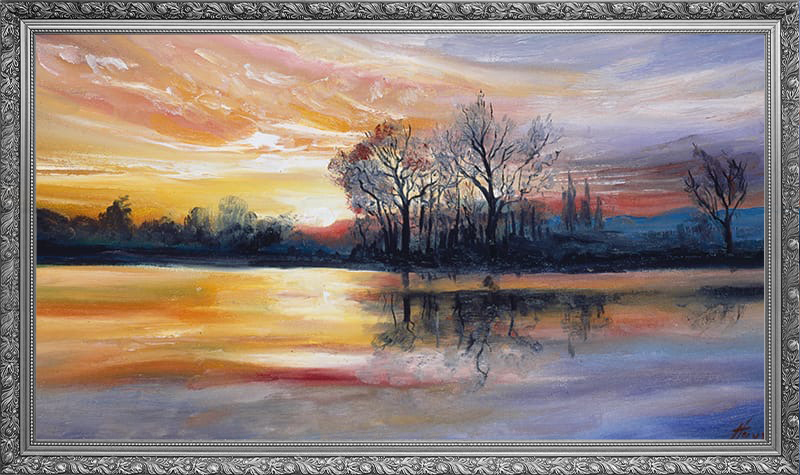
- For a serene, contemplative ambiance: Opt for her ethereal depictions of the Judean hills, her peaceful landscapes, or the quiet, mystical alleyways of Safed, dominated by soft blues, golds, and emerald tones.
- For a vibrant centerpiece: Choose her magnificent, motion-filled scenes of celebrations at the Western Wall, holy festivals, or dancing figures, rich with fiery oranges, deep reds, and striking white highlights that radiate celebration and joy.
3. Harmonic Color Integration
Look at the dominant tones of your current interior design. If your living room features a neutral, minimalist palette (creams, beiges, and natural woods), a vibrant piece of Huvy’s art will serve as a breathtaking focal point, injecting warmth and history into the room. If your space is already rich with color, select a painting from her biblical text or landscape series that anchors those tones through its deep, grounded blues and majestic golden hues.
A Legacy Investment in Fine Art
The international art market recognizes that true value lies in authenticity, cultural provenance, and historical significance. Over the decades, Huvy’s work successfully established her as an authentic voice in modern Israeli expressionism, moving away from commercial souvenir art to capture the true spirit of the land. Following her passing in 2023, the artistic output of Elisha Huvy became a finite corpus of work, highly coveted by serious art enthusiasts and collectors.
Her work has been showcased in prominent regional exhibitions and acquired by major private collections across Israel, Europe, and North America. In a world increasingly dominated by mass production, art that stems from genuine personal and spiritual inspiration remains a rare commodity. Collectors from New York, London, and Jerusalem invest in her paintings because they understand that they are acquiring a piece of Israel’s living history—cherished family heirlooms that pass down a legacy of faith, beauty, and cultural pride from one generation to the next.
Welcome to Huvy’s Gallery: Bring the Spirit of Jerusalem Into Your Home
At Huvy’s Gallery, we are dedicated to preserving and sharing the extraordinary legacy of Elisha Huvy. Located in the heart of Jerusalem, our gallery offers a curated selection of her original oil paintings, limited editions, and high-quality fine art prints.
Whether you are looking to anchor your living room with a magnificent depiction of the Western Wall or seeking a serene biblical landscape to bring peace to your home, we invite you to explore our collections. Our team provides personalized guidance for art collectors worldwide, ensuring a seamless acquisition process.
Contact Our Gallery Curators to arrange a private virtual viewing or to inquire about worldwide, insured white-glove shipping.
Frequently Asked Questions
Unlike traditional artists who painted strictly from life, still models, or photographs, Huvy created much of her artwork based on internal visions, memories, and her imagination. Her background in European art principles, developed in Paris and London, combined with her deep immersion in Jerusalem’s spiritual landscape gave her paintings a distinct kinetic energy.
Yes. Over her long career, Huvy’s work gained significant critical acclaim, documented by major publications such as The Jerusalem Post and cataloged within institutional Israeli art frameworks. Her established gallery in Jerusalem (founded in 1985) has long served as a key hub for collectors seeking documented, high-provenance Israeli art.
Huvy primarily worked with high-grade oils and acrylics on canvas, employing heavy impasto techniques. She used bold palette-knife strokes and intricate, multi-layered pigment applications to create a multi-dimensional, textured surface. This technical approach allows the artwork to interact dynamically with surrounding light, enhancing the illusion of motion.
Original masterpieces, limited editions, and fine art prints can be viewed and acquired directly through the official Huvy’s Gallery website, or by arranging a private viewing at the gallery’s physical location in Jerusalem. The gallery provides international, insured white-glove shipping for collectors worldwide.